For the first time, astronomers have charted the Lighthouse pulsar magnetic field, tracing the invisible lines that fling electrons across space at nearly the speed of light. Using NASA’s IXPE (Imaging X-ray Polarimetry Explorer), a Stanford-led team read the polarization of faint X-rays coming from PSR J1101−6101 and its glowing nebula, turning a decades-old hunch into a measurement. The result confirms a long-suspected picture of how a dead star’s spin sculpts the space around it — and it hands physicists a fresh puzzle they did not expect.
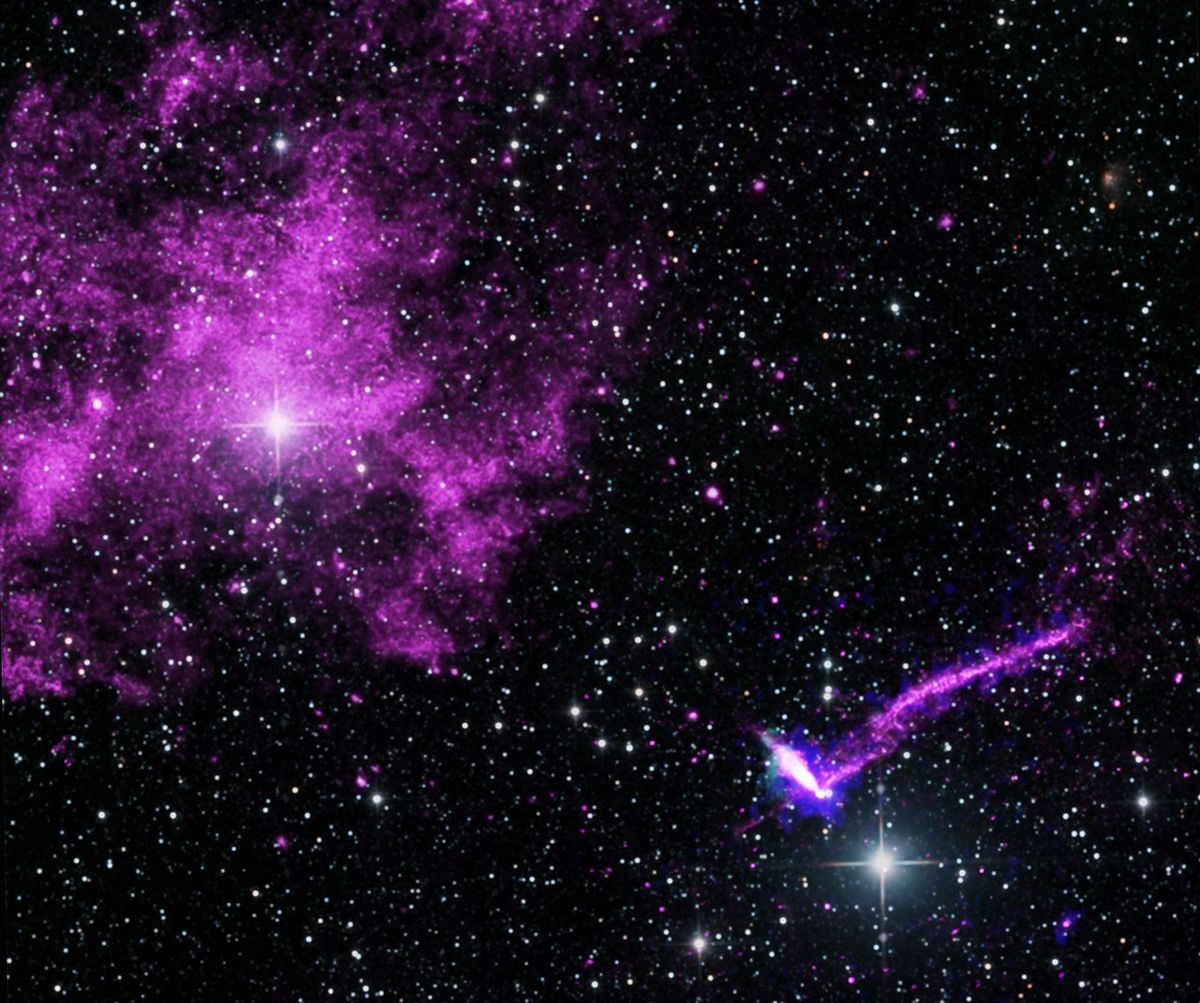
The pulsar sits at the heart of the Lighthouse Nebula, a neutron star packing more mass than the Sun into a ball the size of a city. It spins 16 times a second, and each turn sweeps beams of radiation across the sky like a coastal beacon. That rotation, paired with a ferocious magnetic field, makes the object a natural laboratory for physics no earthbound machine can match.
Mapping the Lighthouse pulsar magnetic field with polarized light
Polarization describes the direction in which a light wave vibrates. When X-rays are highly polarized, their vibrations line up, and that alignment points straight back to the magnetic field steering the particles that produced the light. IXPE is NASA’s first mission built to measure this property in X-rays, and the team spent nearly 18 days in June 2025 staring at the faint nebula to collect enough photons.
Two thin streaks of X-ray light stretch away from the pulsar. The longer one is called the “filament,” the shorter one the “trail.” Since 2008, researchers had suspected that the most energetic particles leak out of the system and ride the galaxy’s magnetic field lines to build the long filament. Proving it required catching the polarization signal in light almost too dim to work with.
The smoking gun that took 18 days to catch
“We wanted to test that theory,” said Jack Dinsmore, the Stanford undergraduate who led the study. “The ‘smoking gun’ would come by measuring the polarization of the light, which indicates the magnetic field direction. If the magnetic field points along the filament, that confirms that the filament’s particles are flowing along the field.”
Because the nebula is so faint, the team could not lean on the usual shortcuts. Instead, IXPE scientists built analysis methods that squeeze information out of every photon rather than throwing data away to simplify the math. Those tools delivered polarization readings for the filament, the trail, and the pulsar’s own emission. The verdict: with more than 99% confidence, the magnetic field runs parallel to the flow of particles, exactly as the escaping-particle idea predicted.
A surprise hiding in the numbers
Confirming the direction was only half the story. The degree of polarization — how tightly the vibrations lined up — came in higher than most models allow.
“Many of the models for filaments assume strong magnetic turbulence,” said Roger Romani, a Stanford professor and co-author. “The high polarization degree we measured indicates lower turbulence than such models require.” In other words, the region is calmer and more orderly than theorists had assumed, which means some textbook descriptions of these outflows will need retooling. Turbulence tends to scramble magnetic field lines and blur the polarization signal, so a strong, clean signal points to a field that stays remarkably tidy even as particles tear through it at relativistic speeds.
When radio and X-rays point different ways
The strangest finding emerged when the team compared wavelengths. IXPE showed the field responsible for the X-rays running parallel to the trail. Radio observations of the same trail showed a field pointing almost exactly perpendicular. Same object, same structure, two directions.
“The striking divergence in magnetic field orientations observed between radio and X-ray wavelengths provides compelling evidence for the highly structured nature of these objects,” said Niccolò Bucciantini of the Italian National Institute for Astrophysics. He called it the first clear sign that particles of different energies occupy distinct regions of the system, hinting at more than one acceleration engine at work inside a single nebula.
Why this matters beyond one dead star
Pulsars are among the extreme environments that let scientists test physics at densities and field strengths impossible to build on Earth. Pinning down how they accelerate particles feeds into bigger questions about the origin of cosmic rays — the high-energy particles that constantly rain onto our planet. A cleaner map of one system gives researchers a firmer template for the rest. For more discoveries from telescopes and the labs behind them, browse the AXO News science desk.
IXPE is a joint effort by NASA and the Italian Space Agency, with collaborators in a dozen countries, led from NASA’s Marshall Space Flight Center. The Lighthouse results were published in the Astrophysical Journal and detailed in a report from NASA. The mission continues to point its optics at magnetars, black holes and supernova remnants, each observation adding another data point to a picture of the universe that only polarized light can reveal, according to NASA’s IXPE mission team.
— Priya Nair, science desk, AXO News